

Interview with Dr. Lafi S. Khalil
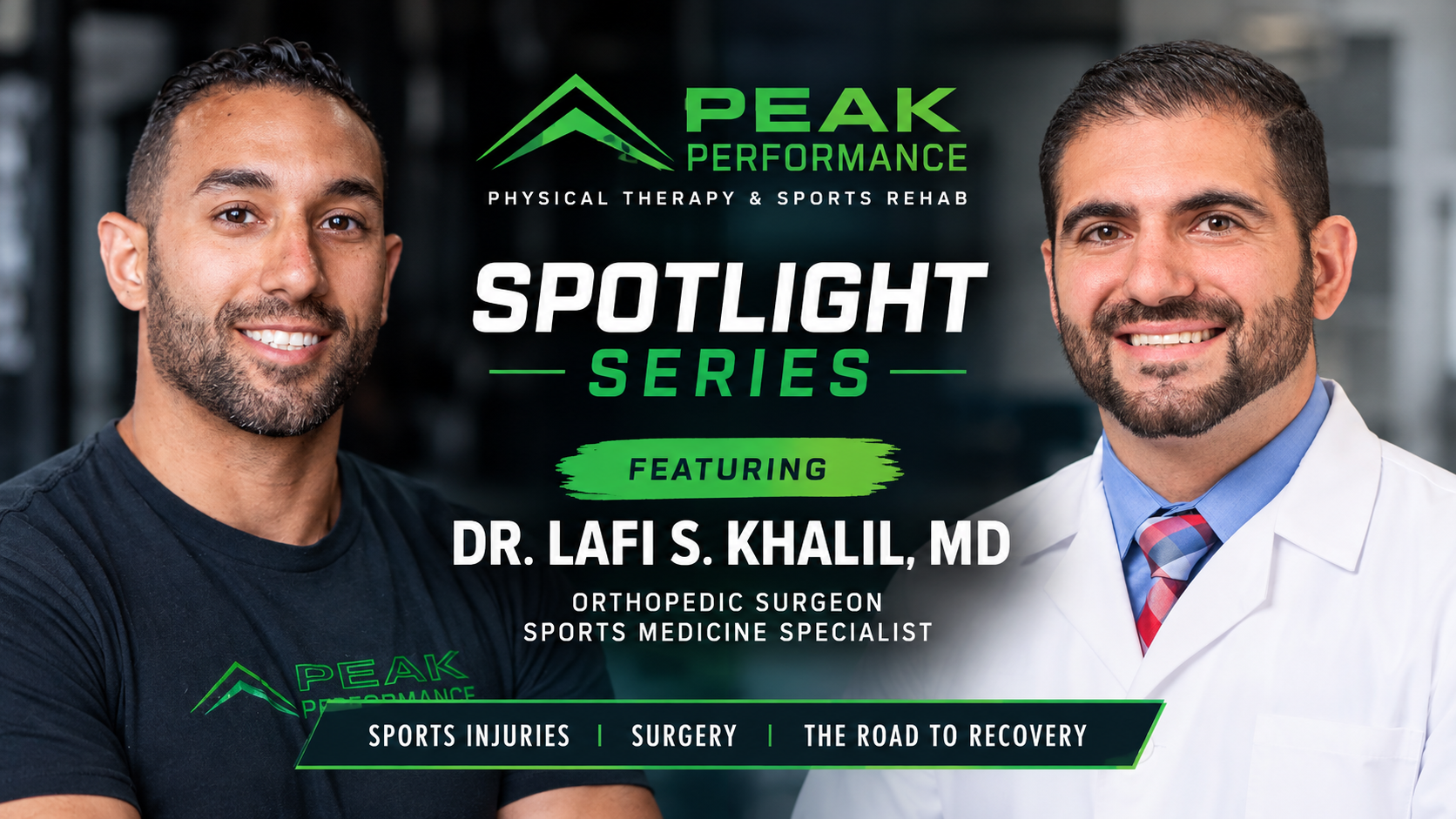
Spotlight Series Topic: Sports Injuries, Surgery, Physical Therapy & the Road to Recovery with Dr. Lafi S. Khalil, MD
Guest Name: Dr. Lafi S. Khalil
Guest Credentials: Dr. Lafi S. Khalil, MD, Orthopedic Surgeon; Sports Medicine Specialist
Discussion Details: In this Peak Performance Spotlight Series interview, we sit down with Dr. Lafi S. Khalil, MD, Orthopedic Surgeon and Sports Medicine Specialist, to discuss common sports injuries, treatment options, and the role of physical therapy in recovery.
Dr. Khalil shares insights into when an injury may require evaluation by an orthopedic specialist, how surgeons determine whether surgery or conservative treatment is appropriate, and how physical therapy can support recovery both before and after surgery. We also explore the importance of rehabilitation, strength and functional testing, and safely returning to sports, exercise, and everyday activities.
Whether you’re an athlete, an active adult, or someone navigating an orthopedic injury, this conversation offers practical guidance to help you better understand your treatment options and recovery journey.
Benefits of Watching:
1) Recognize when to seek care: Learn when joint pain or a sports injury may warrant evaluation by an orthopedic specialist.
2) Understand your treatment options: Discover what factors influence the decision between conservative treatment and surgery.
3) Learn the value of prehabilitation: Understand how physical therapy before surgery may help prepare you for recovery.
4) Navigate postoperative rehabilitation: Learn how physical therapy helps restore strength, mobility, and function after orthopedic surgery.
5) Return to activity safely: Understand why being pain-free isn’t always enough to return to sports, running, or lifting.
6) Protect your long-term performance: Take away practical advice for managing injuries, maintaining joint health, and staying active.
At Peak Performance Physical Therapy & Sports Rehab, we believe that collaboration between orthopedic specialists and physical therapists is essential to helping patients recover, perform, and get back to doing what they love.
Address of guest’s business: https://www.lafikhalilmd.com/
Tony Faraj: Welcome to Peak Performance, our spotlight series. We like to connect with experts in orthopedic care, sports medicine, and performance. Today, I have the privilege of being joined by Dr. Lafi Khalil, an orthopedic sports medicine surgeon, to discuss some common sports injuries, when surgery may be necessary, and how physical therapy helps patients get back to doing what they love. Dr. Khalil, thanks for joining us today. For those, for the people who may not be familiar with your work, can you elaborate and tell us a little bit about your background in orthopedic sports medicine and the types of patients and injuries you commonly treat?
Dr. Khalil: Yeah, thank you for that introduction, Tony, and thank you for this opportunity and for having me here as a guest. Yeah, you know, my background is orthopedic surgery, which means that I did a residency after medical school that involves five years of orthopedic surgery training, which is the full breadth of orthopedic surgery. And then after that, I did one additional year of subspecialty training, which is called a fellowship, and that was in sports medicine. And I did that at the Cleveland Clinic in the sports medicine department over there. And, you know, sports medicine is a really broad field. Within orthopedic surgery, sports medicine is probably like the primary care of orthopedic surgery, because if you get injured being active, and you want to go get checked out, you might end up in the sports medicine doc’s office. And the same goes for non-operative sports medicine. So there is a separate field within sports medicine of non-operative care by primary care physicians who did residency training in specialties other than orthopedic surgery, who also subspecialize with a fellowship in sports medicine. So kind of the catch-all for acute, athletic, or active injuries. And so within sports medicine, you know, we treat everything from sprains, strains, tears, ruptures, you name it.
Tony Faraj: Yeah, thanks for that. So talking about injuries, this takes us to our next point. If somebody were to develop knee or shoulder pain during activity, exercise, whatever it may be, how do they know whether they should rest it, start PT, or see an orthopedic surgeon? What are some of the warning signs that they should look for?
Dr. Khalil: Yeah, you know, that’s a great question, because if you don’t have experience with injuries or kind of what to look out for, you might go to the emergency department unnecessarily and, you know, wait for a long, you know, 10 hours or something for something that could have waited until you saw your primary care doctor or your local orthopedic surgeon the next day or the next week. In general, what I would recommend is this. If you have an injury, whether it’s during a sport, particularly like a collision sport, or whether you’re falling off a bicycle or, you know, something high impact, if you have an injury that acutely changes your ability to walk, range of joint, so, for example, if you hurt your knee and you can’t move your knee, if it’s associated with extreme swelling or pain or some of these red flag signs, then you might want to get that checked out sooner rather than later, particularly if there’s an obvious deformity. So what does that mean, obvious deformity? You know, if you are in a football game or if you fall off your bike and you land on your shoulder and all of a sudden your collarbone is sticking up, and it’s tensing the skin, you should probably go to the emergency room. But if you fall on your shoulder and you just have a banged-up shoulder that hurts but it looks okay, there’s not an extreme amount of swelling, you can still move your shoulder decently, that is something that you can probably wait a little bit. Now, the second part of your question is: how long do you wait? Who do you see next? In general, what I recommend is that most of these injuries that are bumps and bruises, strains and aches, they get better with time. And so even if you saw me the very next day and your shoulder is hot, red, and angry, after I evaluate you, I probably will tell you, okay, let’s give it a few days for a week and come back again for reevaluation because nine times out of 10, it gets better with time, ice, rest, anti-inflammatories. If you give it a few days or if you give it a week and it does not get any better, and in fact, if you notice severe limitations in range of motion, severe limitations in strength, or all of a sudden you have an abrupt inability to raise your arm or to bend your knee or to walk, then that’s something you’re going to want to get checked out. And I think the third part of your question was: who should you see, a physical therapist or an orthopedic surgeon, a primary care doctor? I think that accessibility is different for different people depending on where you live and if you’re already established with a provider. And so I wouldn’t worry too much about that. If you have a good relationship with your primary care doctor and you can get in and see them right away, go for it. Your primary care doctor sees these things probably way more frequently in high volume than most people, and most providers is what I mean. They see hundreds and thousands of patients, and so by the sheer volume, they know what to do, and they’re well trained to kind of rule out the red flags. If you have something that is slowly getting better and you can range your shoulder, you can range your knee, you can walk on it, but you’re in pain, I think physical therapy is a great place to start because I think Tony would agree with me that movement is medicine.
Tony Faraj: Absolutely.
Dr. Khalil: But when you give it a little bit of time, and there’s something severely wrong, you can’t move your shoulder, you can’t move your knee, you can’t walk, you have absolutely zero strength, you go to lift your arm, and it drops, you can’t lift it. That’s something where we get concerned that maybe there’s a full tear, a full rupture, especially if it’s associated with severe swelling and pain, and that probably needs to be evaluated first by an orthopedic surgeon or another physician that has experience with that. And Tony, correct me if I’m wrong, but if that situation occurred and they walked into your office for the first time and they couldn’t even walk on their knee, would you touch them and play around with them, or would you tell them, ” Hold the horses, go get checked out?
Tony Faraj: Oh, yeah. I mean, we would send them immediately to get imaging if they didn’t have imaging. So referring back to a primary care provider because in Michigan, we have direct access, right? We see a lot of patients who come in, and they haven’t even seen a PCP; they haven’t seen an ortho. And so after we evaluate, I mean, we’ve got some clinical prediction rules that we follow, right? And if there are some red flags, we’re sending you out. We’re not going to try to treat that, right? We want somebody, a professional, to eye on that before we even touch them. So yeah, we do have some cases that come in like that and just like, dude, have you not seen any other professionals besides us? And it’s interesting, like you said, I don’t think people understand how to triage their symptoms, who they should see first, right? And I think that’s where patients being comfortable and familiar with what they have access to makes a big difference. But how many people do you see end up in the ER first before they, you know, could have saved time by going to see their PCP, or, you know, their PCP sends them, or they get a referral from an ortho. So yeah, I would agree with you. Like, you know, seek out a professional, whoever you feel comfortable with. And then they’re going to, they’re going to direct you to the next best referral, whoever that may be. And you kind of touched on this. Go ahead.
Dr. Khalil: Oh, I was just going to segue and say, you know, with the direct access model, you know, you may have seen a patient for their, you know, lower back or something months ago, and then now they tweak a knee or tweak a shoulder. And so you’re, you’re the first access point for them.
Tony Faraj: Yeah. Right.
Dr. Khalil: And so that’s, that brings me back to my point about accessibility. You know, if you’re someone they already feel comfortable with or have a relationship with, then they’re going to come to you first, and that’s a hundred percent. Okay. But there are obvious warning signs that, hey, maybe physical therapy isn’t the right answer now because your bone is sticking up through your skin. Right. You might have a collarbone fracture, or there are signs where you would evaluate them and say, Hey, well, you know what? I don’t feel any deformity. I can range you, you know, pretty well. You probably have a little bit of a contusion. Let’s work through it for a few days. And so, you know, just having that comfort with who you’re seeing and the accessibility of care is a big thing. And then knowing what the warning flags are, like you said.
Tony Faraj: Yeah. And I think that’s super important in our field because we have direct access; we should be more aware of what those signs are, what those red flags are, when to refer out. So I think it puts a lot of, a lot more pressure on our field to make sure we’re on top of this and making sure that we’re educating ourselves on what those areas of concern or red flags are in order to refer out. So you kind of touched on this already. One of the biggest concerns actually that patients have is whether an injury will require surgery or not, right? What factors help you decide whether somebody can recover with conservative treatment, including PT, or if they need surgery? And you and I talked about this a little bit, I think maybe last week or a couple of weeks ago on, you know, I think we talked about ACL, for example, regeneration, spontaneous regeneration. So touch on a little bit of that. What factors help you decide whether somebody can recover with conservative treatment or whether they’ll need surgery?
Dr. Khalil: Yeah, it’s a really interesting question because there are a lot of schools of thought, and also, you know, every injury is different. So I’ll try to keep this generalizable to most situations. But I’ll start off with an analogy. If you break a bone, and the bone is completely displaced and deformed, and in a position where, if it heals like that, you will be severely limited in life. You know, that’s pretty clear-cut and dry: you need surgery, or in some situations a cast, but you need surgery to put the bone back where it should be so that you can walk and function. That’s pretty clear-cut and dry, right? But that’s because most people need that leg to walk on or that arm to use. When you talk about something like a meniscus tear, or an ACL tear, or a rotator cuff tear, it’s a little more nuanced in the sense that what does the patient need out of that? What kind of function do they need out of that? So, and it’s not just an age thing. You know, I have seen 30-year-olds with ACL tears who I’ve recommended non-operative treatment for, and I’ve seen 50-year-olds with ACL tears who play soccer twice a week in a recreational league, and they personally want to return to playing soccer, and I’ve seen those patients have surgery for their ACL. And so it’s not necessarily an age thing; it’s really an individualized treatment for the patient. And when you ask the question, you know, when the patient asks the question, do I need surgery? The first question back is, well, what are your goals, and what do you want to get back to? And so, you know, one more example is this, you know, Tony and I, for those listening, we play basketball together, right? And I think if Tony or I had an injury like an Achilles rupture or an ACL tear, you know, it’s conceivable that we might select non-operative treatment because we need to provide for our families, get back to work, remain functional in other capacities. And also, it’s not the end of the world if, you know, we take two or three years off playing basketball and recover our strength and our mobility. Now, imagine the same scenario in a 15-year-old high school sophomore basketball player or football player with aspirations to play in college. They’re a sophomore; they tear their ACL. Their junior year, which is the next year, is the most important year for their recruiting, right? In that scenario, let’s say the 15-year-old asks me, hey, I tore my ACL; do I need surgery? What I would tell them is, listen, there’s some literature to suggest that some people without surgery might have, like you mentioned, some healing of their ACL. Those studies, some of them that, you know, were published, show about 33%, so about one-third of patients on an MRI show that the ACL may have rehealed. And then you follow those patients out long-term, and you notice they still have some residual laxity; some may be copers, some may not be copers. And this term copers is, you know, people with an ACL tear who feel like they have a stable knee, they’re copers. And even in those scenarios, whether they were a coper or not, it took several months of physical therapy before you determined if they were a good coper or not. And so for the sophomore who tears their ACL in October and wants to play football their junior year starting in August, they don’t have the luxury of time to do three months of physical therapy until January, discover they’re not a coper, have surgery in February, and then their recovery starts in February, and then they miss their entire junior season of football. So for that particular patient, they want surgery ASAP so they can play the next year. But if I tore my ACL today and you told me, hey, we can do six months of therapy, then determine if you’re a copter, and then you might or might not need ACL surgery, I’m in no rush to get back to playing sports. And if it made more sense for my life not to have surgery, it’s something I might consider. So it really has to be an individual treatment. And it’s, you know, and I just kind of touched on those examples. But it’s, there’s a lot more that goes into it, too, in terms of not just age, activity levels, sports you’re getting back into, but, you know, other concomitant injuries or injuries that can occur at the same time as an ACL, for example, that might, you know, move the needle one way or another, for example, like a big meniscus tear that you might need to repair. So getting into the weeds a little bit, but that’s the general answer.
Tony Faraj: Yeah. Yeah. Thanks. Thanks for clarifying that. I think that’ll be helpful to our audience who are going to be listening to this video. So some of the common sports, going on to some common sports injuries, you treat a wide range of sports injuries. Which injuries do you see most commonly or most often in active adults and recreational athletes? And are there any common mistakes that people make when they’re trying to recover on their own? Because, I mean, you probably see it in here a lot, like people probably see you a year later, and they’ve been dealing with this injury. And they’re just like, well, you know, I tried to do X, Y, and Z; ChatGPT told me to do this. Or, you know, I followed some Instagram guy who said to, you know, I could fix it by doing X, Y, and Z. So what are some common mistakes that you see or hear people make when they’re trying to recover on their own?
Dr. Khalil: Yeah. By far, the most common thing we see in active individuals is overuse injuries. An overuse, you know, an overuse injury is just a vague way of describing a repetitive and frequent activity or motion without adequate time to rest and recover. Now, if you want to dive into that deeper, what is rest and recovery? Rest and recovery is, you know, rest and recovery is good sleep. It’s good nutrition. It’s good sunlight. It’s a good mental state. It’s good warm-ups and cool-downs and stretching. It’s good mobility. It’s adequate protein intake, you know, it’s everything. So, you know, it’s not, you know, it’s not binary, it’s all on a spectrum. So if you’re doing if you’re doing a lot and not giving your body the chance to recover, you’re really burning the candle at both ends. So overuse injuries in terms of actual pathology, pathology or injuries, strains, and sprains are the most common. So ankles, ankle sprains, hamstring strains, you know, these types of pulled muscles or, you know, sprained knees or ankles are the most common. And those are the ones where, you know, when you ask what the most common mistakes are that you see people make, the most common mistake is not being patient with it. I see a lot of, you know, for example, like teenagers or young adults with ankle sprains, and they’re frustrated two weeks later that their ankle still hurts. You know, we know these types of soft tissue injuries, you know, the initial process of healing can take, you know, six weeks is kind of a minimum; like that’s, that’s the best-case scenario, six weeks after an ankle sprain, but that doesn’t mean your ankle’s never going to hurt again. You know, a lot of us who have had ankle sprains playing sports deal with the ankle pain for three to six months after. And so the common mistake is going back too soon or going back at full intensity and full frequency before you’re ready. So, you know, Tony, I’d be interested to, you know, see how you manage these patients with like, a hamstring strain or an ankle sprain. My philosophy is that obviously movement is medicine. It’s good to get them moving early, but it’s got to be a graduated process where they build their capacity. And one of the mistakes that people make I find, is that if they were running 20 miles a week and they sprained their ankle, yeah, they might take a week or two off, but when they get back to running, they get back to running 20 miles a week.
Tony Faraj: Yeah. Yeah, exactly. And I think that’s where a lot of patient education plays a vital role because people don’t understand what is going on with their injury and what their body is doing, right. In terms of inflammation. Inflammation is not bad, right? Inflammation is a good thing. And the first thing people do is throw ice on it. Right. And now all of a sudden their pain has reduced, but their function hasn’t improved just because their pain has changed. Right. And so educating people on the timeline that it takes for proper tissue healing- you know, this isn’t a two-week process for an ankle sprain, depending on the grade of sprain as well, right. The level of the sprain. And so we see it a lot. People want to get back to doing what they enjoy doing, and they get back to it a hundred percent rather than gradually getting back into it. Runners, especially that’s a, that’s a big market where you see, you know, people run themselves into an injury, and as soon as they’re pain-free, what are they doing? They’re running the same volume that got them to that injury in the first place. Like, dude, what did you not learn from this? And then they run themselves into another injury or a different injury. And so, yeah, we see that a lot. I mean, it’s really.
Dr. Khalil: Yeah, I mean, injuries can be really humbling because, you know, it’s, it’s hard to take a step back and then, and then have to build back up. Right. When you’ve spent, when you’ve spent so much time and dedication to gain a certain level, but you know, what you don’t want to do is one step forward, two steps back. Right. You want, you want to be taking two, three, four steps forward, and an injury knocking you back one step, and then continue building from there. So if you’re, if you’re active for long enough, you’re going to have some kind of injury. So being prepared for that and then understanding how to navigate it is important. And that includes appropriate expectations. Yeah.
Tony Faraj: Yeah, that’s good. Going to, let’s talk a little bit about PT. Everybody, everybody understands that PT after surgery is usually a common thing, right? Somebody has surgery, and then they get referred to PT. But what some people don’t understand or know is that there’s just as much benefit to prehab, right? PT before surgery. And I know you’re kind of an advocate for that as well. You’ve sent some of your patients in for PT before surgery. Elaborate on some of that. Why, why would it be important for somebody and it’s not for everyone, but why would it be important for somebody to go in and seek PT, do some PT, before going in for surgery? And how can that improve, you know, their strength and mobility, their function leading up to surgery, and how does it affect recovery afterwards? Does it affect recovery if they do PT before versus not?
Dr. Khalil: Yeah. I mean, we’ll start with the conclusion. Absolutely. Going into surgery in the best shape possible has been shown in the literature. So it’s evidence-based to improve outcomes after surgery. So that’s the, that’s the take-home message. But to answer your question a little more head-on, you know, when you have an injury and assuming we’re talking about a surgical injury, cause that’s that’s the question. So, like if you have an ACL injury or a rotator cuff injury and you’re planning for surgery, that joint is red, hot, and angry. It’s inflamed, and the joint is controlled by the muscles that cross that joint. So for the knee, you’ve got the quadriceps and the hamstrings that cross that joint and act on the knee to extend and flex it. And those muscles tend to, you know, I tell patients in layman’s terms, you know, these muscles shut down; they play dead. The pain pathways that are triggered by your injury are, you know, shutting down the neural pathways to contract those muscles. And that’s why even if you take an athlete with an acute ACL injury and even a week after their injury, if you look at their legs, they’ve clearly already had some atrophy in their quads, for example, is a big one. And so if you do no prehab or if you don’t restore your range of motion or some baseline strength, and you go into surgery already with the red-hot, angry joint and with muscle atrophy, surgery is another trauma; surgery is not a benign event, you know, and I often tell patients that surgery is a controlled trauma. You know, it’s not like when you were on the football field and buckled your knee, and it snapped. It’s not the same thing, but it is a controlled trauma. We’re putting instruments in the knee; we’re dissecting through, you know, layers, and that’s going to produce a similar inflammatory insult to the knee, which could be a double whammy effect. And so rather than going into surgery already knocked down and then having that double whammy, it’s good to let you know, give the joint a few weeks, three to four weeks at minimum, to cool down and restore range of motion through that joint. And then, really important, that’s been borne out in the literature, is trying to restore as much quadriceps and hamstring strength around the knee so that you go into surgery with full range of motion, excellent strength. Now, it’s almost a synergistic effect. Because if you go into surgery with the red-hot, angry knee, and then you have, you know, a surgery done, that second whammy is even synergistic or exponential on the knee. But if you go into surgery after some prehab, and your knee is really cooled off and calmed down, that trauma of that surgical event is not going to trigger as bad a response. And then your postoperative rehab, regaining your quad control, regaining your muscle activation won’t be such a challenge. And you’ll see a lot earlier achievement of the range of motion and strength parameters that we like to see after surgery. And not to mention the pain control that comes with that.
Tony Faraj: Yeah, yeah, I think there’s a lot of value. I mean, I, from the patients that I’ve seen, where surgeons have referred them to PT before versus, you know, they start PT after the education that they get ahead of time, prepping them for what surgery is going to be, what they’re going to experience after surgery, right? A lot of them are just like, I didn’t think I’d be in this much pain; I thought it would all be just better, right. But it’s just like educating on that early on. But also, as you said, calming down the joint, getting some of those neural pathways to wake up, getting some of those muscles to engage using things like blood flow restriction therapy to help mitigate some of that atrophy, right. But utilizing all of that creates a much more successful outcome post-surgery. And, and you might see it, I don’t know, but would you say that people tend to recover quicker or have a shorter recovery? And I’m not talking like, they’re going to speed up their recovery by two months. But like, do you tend to see that their progress tends to be a little bit quicker for those who’ve had prehab versus just going into therapy after surgery?
Dr. Khalil: Yeah, you know, I think the biggest benefit is, is pain control. As I said, I’ve noticed a reduction of needing refills at the first post-op visit. And then also, you know, the simplest thing we do is just ask a patient to do a straight leg raise. And for those on the call who don’t know what that is, you know, when a patient is lying down and their leg is lying on the bed, you just ask them to raise their leg up. And at the first post-op visit, it’s common that patients don’t have the strength to do that just yet. But those who are really diligent with preoperative physical therapy or prehab, oftentimes they can do that a lot easier, because they have much better muscle control. In terms of getting their range of motion back, that becomes much less of a challenge in patients who have done prehab. And then I think there’s, you know, you said something that made me think of this. And I think that an important point is that you’re not just setting expectations, but you’re also building a relationship. When you spent, you know, when you spent two to four weeks with a patient before surgery, and they’re comfortable with you, when they go to you after surgery, and they’re vulnerable, and they’re in pain, and they’re swollen, and they’re scared, but they know that you’re going to take care of them, they will trust you with their painful post-surgical knee or shoulder or whatever the case may be. It’s like if you went to someone for a haircut right before your wedding, and they’d never cut your hair before, you’d be, you know, you’d be a lot more nervous. But if they’d cut your hair many times before, then you wouldn’t even sweat it, you know. And so I think that that’s also an important component, because if you’re seeing a patient for their first post-op visit after an ACL, and you’ve never ever met them before, that patient’s going to be a lot more apprehensive with letting you touch and treat them.
Tony Faraj: Yeah, that’s good. That’s a good point. That’s one thing that I didn’t think about, but that’s a very good point you make there. Let’s segue into returning to sports and exercise. So the patient has had surgery, they went through therapy, and now they’re wanting to return to sport and exercise. For an athlete or active adult who wants to get back to running, lifting, sports, whatever that is, how do you determine when they truly are ready to return to back to sport? Is it, is being pain-free enough? And this doesn’t even have to be surgery; it could just be, like you said, an acute trauma. Is it, is being pain-free enough? Are there any other strength or functional milestones that you look for as an orthopedic surgeon that you want to see in your patients before you feel comfortable with them returning back to sport?
Dr. Khalil: Yeah, so there are a couple different ways to look at it. You know, there’s timeline-based, and there’s milestone-based, right? And so when I say timeline-based, we’re talking about, like we were talking about with ankle sprains, you can’t speed up biology in most cases. And so since we’ve been talking about ACLs, let me just, you know, give an example. There’s evidence that, you know, when you do an ACL surgery and an ACL reconstruction, the ACL that you recreate undergoes a process called ligamentization, and that process takes about three months for that ACL to mature enough. In those first three months, it’s the weakest it’ll be. So most ACL protocols tell patients and therapists to avoid jogging or running on a reconstructed ACL for the first three months. That’s a timeline-based restriction, and that’s rooted in biology. That’s not something that you can necessarily speed up. But not everyone can start running at three months, right? There’s milestone-based also. And so from a milestone-based perspective, that’s where I put my trust in the therapist because they’re the ones truly evaluating things like symmetry and strength between legs, things like range of motion equivalents. And so when I’m evaluating a patient in office, the way that I try to determine their progress is I’m comparing their injured side or their reconstructed side, their surgical side, et cetera, with the other side. So if it’s their arms, I’m comparing range of motion in their shoulders, their elbows compared to one another, strength compared to one another. I’m always inspecting, you know, with a gown on or a shirt off, their shoulder blades, the way that their shoulders move. So you want, you know, pretty symmetric motion, pretty symmetric strength. We all have asymmetries and strength discrepancies side to side. Literature shows about 10 to 15 percent. And so it’s not about being perfect, but it’s about having good muscle control and being darn near symmetric. In addition to that, you asked, do you have to be pain-free? I think it depends on the injury, right? If you had an injury that, you know, is dangerous, like, for example, if you have a lot of pain in your ankle or your knee because you sprained it and we treated you without surgery and you’re like, I want to get back and play, and you’re still limping because you’re in pain. I get concerned, especially with the teenagers who never tell you the truth, right? They never tell you how bad it hurts because they want to get back to play. I get concerned if all their attention is focused on their bum ankle while they’re out there, they might not pay attention to the person coming to tackle them, and they might get a concussion, or they may, they might injure a different or different body part. Right. But if you have, if you have some pain with some shoulder motion and you’re an older individual wanting to play pickleball, I think it’s safe for you to try it. Right. And you can try it. And I tell patients, listen to your body; let pain be your guide. And you can modify; you can modify how big your swing is, how fast and intense your swing is. So there are things you can modify to do your activities in a more symptom-free zone. So I, you know, I don’t want, I don’t want a complete shutdown, but I want to be mindful of what’s irritating your existing injury so that you can still enjoy life and feel like you’re progressing through the, through your, to your goals, but without suffering setbacks along the way.
Tony Faraj: Yeah, that’s good. We’re going to come to a close here, but I wanted to touch on one more thing. One thing that I appreciate about people in our health profession is those who practice what they preach. They live out the lifestyle. I know you’re a weightlifter, you powerlift, and you play basketball. You’re very active. Before we end, share with us one piece of advice that you wish every active adult knew about preventing injuries, managing pain, or protecting their joints so they can enjoy many more active years ahead.
Dr. Khalil: Yeah, that’s a great question. I guess I’ll speak from personal experience because sometimes, when you’re competing, training for a marathon, preparing for a powerlifting meet, or participating in a recreational basketball or soccer league, we tend to neglect some of the important things that were ingrained in us when we were kids. When we were growing up and playing sports, our parents always made sure we had enough hydration, proper nutrition, and sufficient sleep. But now we’re adults. We have kids of our own, families, and jobs, and some of those things start to fall by the wayside. One of the most important things is that when your training intensity increases, your recovery and your emphasis on sleep and nutrition must increase as well. I say that, having been guilty of this myself. Sometimes I’m busy, sleeping five or six hours a night, but I’m still trying to push my training harder and harder. If you know you’re approaching a peak training phase or preparing for an event, you have to organize your life in a way that allows you to eat better, sleep a little more, and get the appropriate nutrition you need. Otherwise, you’re setting yourself up for an overuse injury or potentially a more serious injury. The other thing I would say is to be a little more patient. Although we have certain goals and deadlines, if you miss a day here or there, you’ll probably be better off in the long term. You have to listen to your body. There is some pain that we all push through, but if you push through pain that could negatively affect your training in the long term, you might end up having to take three or four weeks off from running, lifting, or whatever activity you’re doing. You would have been better off taking that extra rest day or two when you first noticed fatigue setting in or when life started getting busy. So, I think it’s important to be mindful of all those things. The last thing I would say about training in general is to have a diversified approach. Just as we tell young athletes, if you’re repeatedly performing only one movement or exclusively running, you’re going to overtrain some areas and undertrain others. You need a balanced approach to training. If you’re a runner, incorporate some strength training. If you’re a strength trainer, incorporate activities such as basketball, which I enjoy. Everyone should incorporate some stretching and mobility routines. These can help keep you moving well, even though flexibility work is often the last thing we want to do after a workout or a basketball game. Stretching and maintaining flexibility are important factors, especially as you get older. Keeping your body flexible and mobile is important.
Tony Faraj: Well, thank you for your time. If our audience wanted to get to know you a little better, what are some ways they could follow you? Do you have any social media accounts? If they needed help with orthopedic issues, is there a website that could connect them with you? What’s a good way to follow you?
Dr. Khalil: My website is just my name, Lafi Khalil, MD. It’s lafikhalilmd.com.. My social media accounts are linked on the website, along with my contact information and office information. You can also search for my name on most social media platforms, including LinkedIn and Instagram, to find me. I treat patients of all ages, whether they’re involved in athletic or non-athletic activities. I see patients who aren’t particularly active but who might fall and develop a rotator cuff tear, as well as people experiencing everyday aches and pains. I treat a wide range of sports medicine conditions and joint and muscle problems. I’m happy to help if you ever need me.
Tony Faraj: Thank you, man. Thank you for your time and for doing such great work in the orthopedic field. I look forward to connecting with you again soon. Thanks, Lafi.
Dr. Khalil: Thanks, Tony. I’ll see you on the basketball court.
Tony Faraj: Yep. See you. Bye.