

Interview with Andy and Sydney Bowman
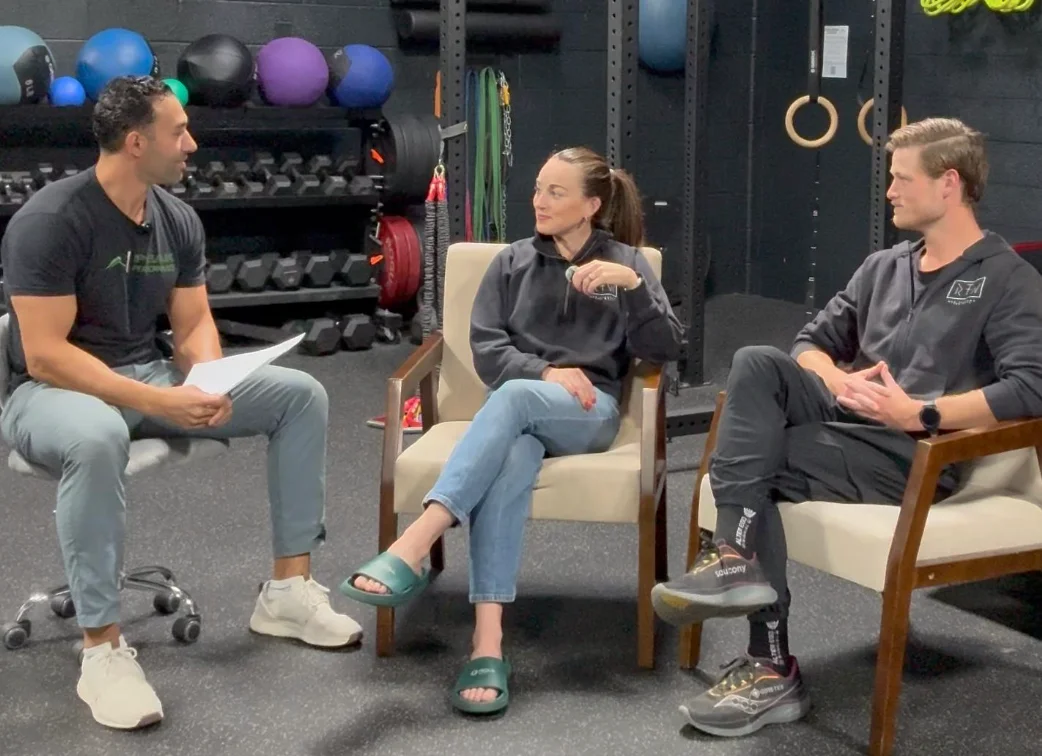
Spotlight Series Topic: Detroit Marathon Champions Andy & Sydney Bowman on Running, Training and Building Run Through the Wall
Guest Name: Andy and Sydney Bowman
Guest Credentials: Andy – NASM-certified run coach, personal trainer, accomplished marathon winner; Sydney – Certified Run Coach and 2-time Olympic trials marathon qualifier
Discussion Details: In this Peak Performance Spotlight, we sit down with Detroit-area runners and coaches Andy and Sydney of Run Through the Wall. We talk about their journey into running, their experience becoming a husband-and-wife marathon-winning team at the 2024 Detroit Free Press Marathon, and Andy’s second Detroit Marathon victory in 2025. They also share what inspired them to create Run Through the Wall, how individualized coaching can benefit runners, common training and recovery mistakes, the importance of strength and mobility, and what makes the Metro Detroit running community so special.
Benefit of Watching: Whether you’re training for your first marathon, chasing a personal record, or simply looking to become a stronger and more consistent runner, this conversation offers practical insight from two accomplished runners and coaches. Andy and Sydney share their perspective on training, recovery, injury prevention, strength, and the mental side of running—while offering advice that runners of all experience levels can apply to their own training.
Address of guest’s business: https://www.runthroughthewall.com/
Dr. Tony Faraj: Welcome.
Sydney Bowman: Thank you. Thanks for having us.
Andy Bowman: Thanks for having us. Absolutely.
Dr. Tony Faraj: We’ll start out with the first question. Take us back to 2024. All right, Detroit Free Press Marathon. You both are running it. What’s going through your mind? You cross that finish line, and then, Andy, you cross that finish line first, then you see Sydney come across that finish line. Tell us about the emotions. Tell us about how you guys felt in that moment, like being the first husband-wife team to complete the marathon as men and women completing as a husband-wife team.
Sydney Bowman: So many emotions. The marathon takes months of training, and I think we had this dream from the minute we signed up that we wanted to try to win it together. And a lot can go wrong, and a lot can go right in a marathon build. And I think I got bronchitis like six weeks out, and you are dealing with something I don’t remember. But it certainly wasn’t a perfect build, and so you know you set these big lofty goals. Then race day comes, and then for it to all come together and actually play out the way that we like dreamed. I think I remember most realizing he was going to win. I was at mile 21 or so, so he was coming back down Lafayette, and I saw he was winning, and I thought he’s doing it. And then I was like, “And you’re doing it? And it’s like, “We’re doing this. Like, this is actually happening. And then it was kind of like, “Now don’t screw it up, because at that point, you still, I still had five miles to go, and I was like, “Okay, you just like basically can’t screw it up now. So yeah, when I made that final right turn and I saw him, it was just like pure joy.
Andy Bowman: Yeah, a lot on the same note there, because there were some things that didn’t go right for us, to put it briefly. So coming into it, we know knew it wasn’t like the perfect build, and things could you know the marathon’s a beast in itself, so you can still, you know, lose it if if you’re not careful with it. So there was some anxiety going into it, but then to pull it off, to cross the line first, and then turn around and see that my wife was the first woman coming across, and have that sense of relief and joy that, oh my god, we did it. There’s, I think I’ve described the moment several times, is surreal. It was just amazing, and you know, probably one of my more treasured memories. So,
Dr. Tony Faraj: yeah, I remember the picture that that was always floating around. You know, you holding Sydney. Just that must have felt so magical. That must have been so cool to experience that together. All the hard work, all the training, you cross the finish line. You get to celebrate together. That’s exciting. Andy, take us fast forward a year later, 2025. Sydney, you were pregnant. You had to sit the next one out. Is that correct?
Sydney Bowman: Well, on the day he was 10 days old.
Dr. Tony Faraj: Yeah, yeah. So fast-forward us to 2025, a year later. What did you learn from the previous year, 2024, that kind of helped get you through the season of training that next year to be able to then accomplish a second win, crossing the finish line as another Marathon finish?
Andy Bowman: So we just said like 2024 hadn’t been perfect. We had some hiccups and some things that didn’t go well. So coming into 2025, it was just one of these things where I’m not ranked as the first guy. They brought in a stud out of college to come and topple me, and so I knew I had that going against me, and then, you know, the weather wasn’t perfect either. So something that I took away from 2024 was knowing like, keep it calm because it doesn’t have to be perfect for you to still have your day, and anything’s possible, a marathon day. So went into 2025 feeling pretty calm and just like, confident in my ability to cover the distance, and you know, whatever happens in between then are there. I can’t control what my competitor is going to do, but I can control my execution, and in doing so, eventually led to the victory. So it was really just do what you can.
Dr. Tony Faraj: Yeah, yeah, that’s awesome. So, is this going to be a threepeat? Are we going to get a third one this year?
Andy Bowman: So I, I don’t ever like to jinx myself because you know anything can go wrong. But I am feeling really strong, and training has definitely pointed in the direction of a really good time in the woods, and should be a top finish, I’ll say, at the very least.
Dr. Tony Faraj: Amazing, and I don’t know if we clarified this in the beginning. This is the Detroit Free Press Marathon that you are training for right now for 2026, and you won it in 2024 together as a couple, and in 2025. Tell us a little bit. About the business that you guys started- you founded Run Through the Wall to help other runners. What inspired you to start the business, and what do you hope runners get from working with you?
Sydney Bowman: I think really Run Through the Wall came to be like something we started to take seriously as like a goal for our lives and and what we wanted to do with our years of experience and our passion of running as we were getting ready for the 2024 Olympic trials, we kind of started talking about what we wanted life to look like and what got us excited and like the career path we wanted, and for us, having both been part of professional teams, collegiate teams, had coaches, we understand the value of a coach. I was already coaching at the time through McCurdy Trained, and I was like, “What if we did this together? We combined our experience. Andy had a lot more track experience than I did. I didn’t really get to run in college. I was injured all the time, so he brought in this like a whole nother area of development that I didn’t have, and I thought you’re so good at like the the five everything from basically the 5k to 10k down. You bring in the strength aspect of it because he was a strength coach. I was like, if we put our strengths together, like, we really could start something. We really have something here, and we really loved our community, and we loved the running community, and so we thought, if we could take this coaching opportunity to build something bigger than us, where we bring people together, and they inspire each other. Yes, we write the training. Yes, we believe in them, we support them, but there’s this other aspect of it, where people feel like they belong to something more, right? So that you show up to races, and it’s not you on the starting line against a clock; it’s you and your teammates and your coach, and you’re all there for this like shared, beautiful experience. And then, fortunately for us, the running boom took off, and it just seemed like everyone wanted to run a marathon, and we. So I think this has really just been a joy to like watch our business grow and at the maybe right time, right place with running. But yeah,
Dr. Tony Faraj: That’s awesome. You want to add anything to that, Andy?
Andy Bowman: I mean, there’s there’s not much more to be said there, minus like maybe for for both of us, like getting to share our passion with people that are are also looking to get into this industry and be passionate about it. I mean that that gives the job real meaning and you know, it’s fulfillment. So that’s been a very enjoyable part of the process, and I think part of what we hope to get out of it.
Dr. Tony Faraj: Yeah, that’s beautiful. So we’ve been talking a little bit about training, training for marathons. There are so many generic training plans out there, right? You guys can agree to that. You’ve probably seen it. I see it in the PT field where somebody comes in and says, “Oh, I’ve googled this. I’ve googled that, right? And they probably do that as well with with training, right? What makes individualized coaching with you guys run through the wall different than all these other generic training programs?
Andy Bowman: I’d say with us, it’s more coming at it from a holistic perspective of like a recognition of we all have some sort of professional career, and now we’re trying to fit running into the picture. So for Sydney and I, it’s about where can we meet you where you’re at, get you started, make sure that we’re focused more on developing the routine and the passion of it. You know, without necessarily getting into the nitty gritty of what we’re talking about with the specifics of training, it’s just creating a plan that helps them get to where they want to go to feel good about it, and then navigating the rest of life with it. Because I think the biggest thing that we run into sometimes with a lot of our newer clients is just you know, they’ve got X, Y, and Z going on, and they didn’t know how to handle it before, but after talking with us, we can help them navigate that. So I think that’s at least something we bring to the table outside of generic templates that won’t tell you, “Hey, your kid kept you up past you know three a.m. Like maybe just forego that next run or something else like that.
Dr. Tony Faraj: Yeah.
Sydney Bowman: Yeah, I think you can relate that sometimes a generic plan does work for some people if things go perfectly and you are you’re exactly sure about the shape you’re in and you already know exactly what paces you should run and you have no your life is very simple and you have no interruptions. Sometimes a generic plan can get you started or get you maybe to a point before you need a coach, but I feel like individualized coaching is the ability to be very adaptive and flexible to, like, the realities of life. And the reality is, you’re not always going to be able to do that run. You’re not always going to hit your paces. You’re not. You’re going to have to adjust to the conditions on the day, whether it’s 30. Mile-per-hour winds, or a 75-degree dew point, or you’re going on vacation with your family, and you’re going to be at altitude, and it’s the generic training plan isn’t going to be able to guide you through the actual like nuances of day to day, like meeting you where you’re at physically and mentally, emotionally, and also sometimes you just need accountability, and I think a generic training plan isn’t going to check in and say how are you feeling, how are you doing. It doesn’t believe in you the way a coach believes in you, and I think belief is 90% of achieving your goal is believing in that goal and having people that support you and believe in your goal also. So
Dr. Tony Faraj: Yeah, that’s good. Yeah, we see we see it a lot as well. I mean, like, there’s nothing better than an individualized plan that’s you know specific to your needs at that moment, right? And that could change, but these cookie cutter plans, this cookie cutter treatment, it’s just just. I think we’re going on to the next question. I think this leads to this: What are some of the biggest mistakes you guys see runners make when it comes to training or when it comes to recovery? Right? What are some things you can touch on over there?
Sydney Bowman: The biggest mistakes that I see is comparing themselves to other people, seeing other people’s training, and trying to do what other people are doing versus recognizing their own limitations and where they’re at right now. I think the other biggest thing is that people tend to run their easy runs too fast, their workouts too fast, and then their long runs too slow, and then they’re never really having recovery days. And then the long run, which is the most important run of the week, if they’re training for a half marathon or marathon, ends up being this slog with poor mechanics and poor form. It’s this social thing with lots of breaks, and so they’re really not getting the quality where they need it. And then their easy runs, they’re not recovering the way they’re supposed to, and then they’re so worried about what other people are doing that they’re like trying to run further than they need to, run more mileage than they need to. So I say that’s probably the biggest thing that we see.
Andy Bowman: One other thing I guess I see is it’s kind of like this martyr mindset of, you know, I may not feel amazing or I’m completely dragging for one of a couple reasons that have nothing to do with running. They’re like, well, I have to do this because that’s what everyone’s doing, and this diehard like I got to push through. Where again, we take kind of that holistic approach where it’s like if you’ve got X, Y, and Z going against you, then we need to modify and actually balance the stress that’s in your life, and that’s not just the training stress, but that’s everything else. Because when you do that, you kind of get into this flow state of I’m just moving with everything in life. It makes it a heck of a lot easier, and it just gives you longevity and enjoyment in the sport, so that’s at least one mistake I see common with my athletes, and they’re often surprised where I’m like, “No, I just want you to take the day off. Like, but I think I should, and it’s like, “No, trust me, you don’t want to do that.
Dr. Tony Faraj: And you kind of touched on it already, but going into our next Question: If somebody in Metro Detroit wanted to run their first marathon, what are some things that you would emphasize? Whether it’s to improve their marathon time, or what is one piece of advice that you feel is valuable to give somebody who is preparing for a marathon, or half marathon, or whatever run distance.
Andy Bowman: So I mean, top of mind for me is always consistency of routine. I think if I had to pick one thing that was really important to the marathon, it’s definitely getting your long runs done, but being consistent with it. Because some of my clients, what I’ll what I’ll see is, okay, we did really good this week, but then the next week we we missed a bunch of stuff and did not get our long run in for one reason or the other. And when you don’t have that consistency of one week stacking on top of the next, it does not bode well. I think it’s the race day because whatever you do end up getting in is just way too hard, and it just leaves you drained for the actual day, so at least for marathoning, or that could even count for any distance. Really, it’s just consistency of schedule and something that actually meets your body where you’re at, and you can do well rather than feeling like you’re dragging or anything else like that.
Sydney Bowman: I agree with everything you said. I think consistency is always the number one thing, but you can’t be consistent if you can’t stay healthy, if you can’t stay injury-free, if you’re not recovering properly. A training block is 16 weeks. Maybe you run five days a week. That’s 80 runs. If you’re missing two to three runs a week. That’s a huge hole in your wall. We like to refer to, we like to refer to your training as like a brick wall that you’re building. And every run you’re like laying a brick, and every time you skip a run, that’s a brick that’s missing in your wall. And like a Jenga tower, you can pull a few blocks out, and it’ll stay up, but you start taking out too many, and you don’t have anything. You don’t really have the base that you need. So, whatever it takes to get just get the run in is like just show up each day. It’s not about how hard you go or how long you go, but more often, like, how often are you showing up?
Dr. Tony Faraj: Yeah, yeah. Consistency over time is always going to win. Yeah, for you guys, who is the ideal runner for Run Through the Wall? Do you primarily work with experienced runners? Do you coach newer runners? Who’s your ideal runner?
Sydney Bowman: We’ve talked about this a few times. For me personally, I like to work with people who have big scary goals. New runners are fun to work with, but I think people who are highly motivated and do have like quantifiable goals, objective goals, it’s fun versus like arbitrary. I just want to lose weight, or I just want to get in shape. People who are setting more like real and measured goals, they’re going to be when things get tough because they will when life gets in the way because it will when you’re not feeling motivated, which is going to happen. Those are the people that are going to that goal is going to be what continues to get them out the door. Versus if it’s kind of a loose, I just want to get in shape. I find they are less likely to commit to, like, see it through to the end. Yeah. So I definitely like to work with people who are motivated by like specific goals. I’d say.
Andy Bowman: So I definitely agree with all of that. The driven part, especially because this sport’s not easy. It’s definitely what we call it: type two fun. So it’s the kind of fun that you only enjoy after the fact, and that can be, you know, off-putting for a lot of people. So somebody that’s going to have success in this is going to be somebody that’s serious about what their running goal is and what that can do for them. But then on that note, even more encompassing, it’s like for me, it’s a lot of people that have a curiosity. They could be beginners. They could have been doing this for a while, one reason or the other. They’re just deciding to take that next step in their journey and start it. And I always love getting to show them the ropes and showing them how they can actually be what they aspire to be. I think one of my favorite pieces of feedback I ever got was one of my clients was in disbelief that, you know, a year ago she struggled to run a block, you know, around the house or where she lived, but now she’s, you know, about to do her first marathon and has logged so many miles and that’s
Dr. Tony Faraj: So cool.
Andy Bowman: Yeah. So when you get to somebody like that, it’s I mean, it’s amazing. I love working with those types of people.
Dr. Tony Faraj: Yeah, that’s got to feel rewarding for you as well as a coach, right? To see that, to see them break through some of that fear or just inability to do something, and now they’re finally able to do it. That’s really cool.